
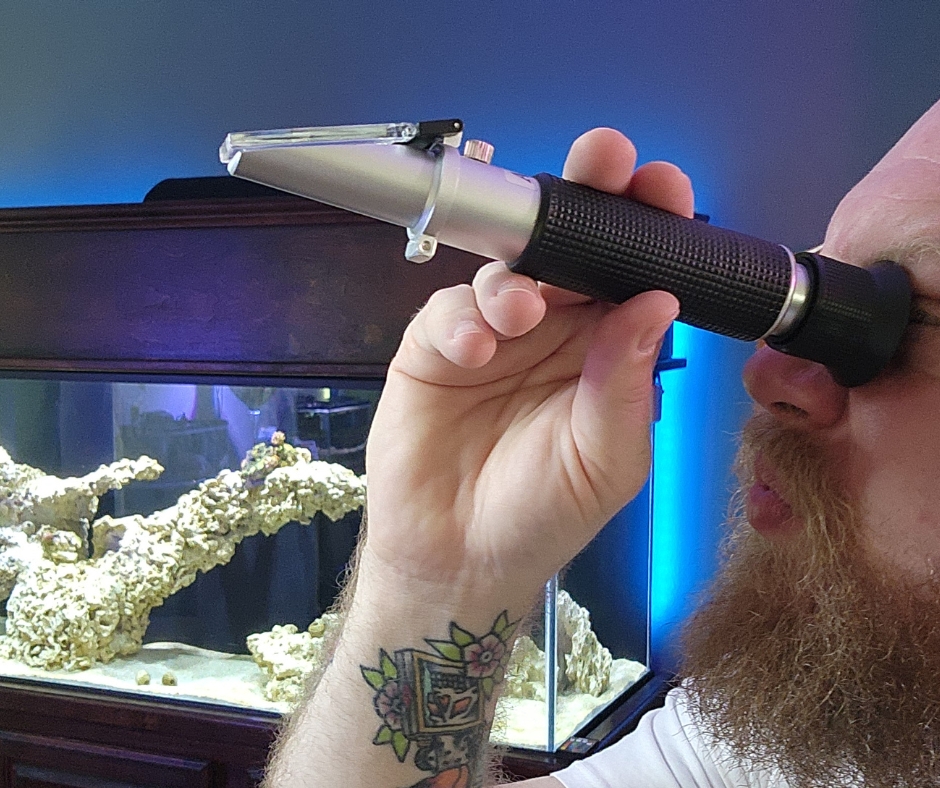
If you own a refractometer, there’s a good chance you’re calibrating it incorrectly, which means your salinity is not actually where you think it is. Let’s talk about why that happens and how to fix it.
The Common Mistake Everyone Makes
Most reef keepers calibrate their refractometer by adding RODI water, closing the lid, and adjusting it until it reads zero.
Looks good, right?
Unfortunately, in most cases, that is incorrect.
There are a few refractometers on the market designed specifically for seawater that can be calibrated at zero. However, most refractometers sold in this hobby are actually brine refractometers. These are designed to measure saltwater, not true seawater, and they are not meant to be calibrated at zero, even though many of them come with instructions that say otherwise.
Why Zero Calibration Causes Problems
A refractometer is a precision instrument, and precision instruments behave poorly when calibrated far away from their target measurement.
When you calibrate at zero, but your actual target measurement is around 35 PPT (1.026 specific gravity), you introduce an error. The farther away your measurement is from the calibration point, the larger the error becomes.
That error can be significant.
Calibrating a refractometer to zero can result in an error of 3–4 PPT, which translates to a specific gravity swing of roughly 0.002–0.003.
That means:
- You might think your tank is at 1.026
- But it could actually be 1.029 (too high)
- Or 1.023 (too low)
- Or anywhere in between
That’s a big deal in reef keeping.
Why Salinity Accuracy Actually Matters
Salinity isn’t just a number we aim for out of habit. It is the foundation of a saltwater aquarium.
Many elements in your tank, including calcium, magnesium, alkalinity, and trace elements, are directly tied to salinity. If your salinity is lower than you think it is, those values will also be lower than expected.
This can lead to a frustrating situation where:
- Calcium always seems low
- Magnesium never quite stays where it should
- Alkalinity needs constant adjustment
In reality, the problem may not be the elements at all. It could simply be that your salinity isn’t what you think it is.
Stability Still Comes First (But Accuracy Matters)
Stability has always been king, and it always will be.
If your tank runs steadily at 1.024, you’ll be fine. The same goes for 1.025, 1.026, or 34–36 PPT. Corals care far more about consistency than hitting a single perfect number.
That said, we do want our numbers to be accurate, especially when we’re making decisions about dosing, supplementation, and trace elements.
You can’t manage what you’re mismeasuring.
The Science Behind This (And Where It Comes From)
Most of the information behind this issue comes from an article written by Randy Holmes-Farley, who breaks down the science behind refractometer calibration errors in detail.
If you want to really dig into the chemistry and physics behind it, you can read his article here: https://reefkeeping.com/issues/2006-12/rhf/index.php#11.
The Right Way to Calibrate a Refractometer
Use a Proper Calibration Solution
Instead of RODI water, you should be calibrating with:
- A commercial 35 PPT calibration solution, or
- A carefully made DIY solution
Commercial solutions are inexpensive and generally reliable, though even those can sometimes be inaccurate. That’s why I personally verified mine using ICP testing to confirm that it matched.
Making Your Own Calibration Solution (DIY)
If you want a calibration solution you know is correct, you can make one yourself using pure sodium chloride, not marine salt.
Recipe:
- 3.65 g sodium chloride
- 96.35 g purified RO/DI water
Mix thoroughly until fully dissolved, allow bubbles to dissipate, and you now have a true 35 PPT calibration solution.
This method is also detailed in Randy Holmes-Farley’s work and is extremely accurate when done carefully.
ATC vs Non-ATC Refractometers
Check your refractometer for the label ATC (Automatic Temperature Compensation).
If Your Refractometer Is ATC:
- Temperature differences are automatically corrected
- Matching temperatures is not required
If Your Refractometer Is NOT ATC:
- You must temperature match your calibration solution to your tank
- One easy method is floating the calibration solution bottle in the tank for 15 minutes
Failing to temperature match will result in incorrect readings.
How to Calibrate Step by Step
- Place calibration solution on the prism
- Close the lid
- Wait 30 seconds
- Look through the eyepiece and focus
- Use the adjustment screw to align the blue/white boundary with 35 PPT
- Clean the prism with RODI water and dry thoroughly
Always check calibration:
- Before first use
- After shipping
- Every time it is used
Shipping vibrations and temperature swings can knock calibration off, even on brand-new units.
Other Ways to Measure Salinity
Swing Arm Hydrometers
- Prone to bubbles and user error
- Not recommended, especially for beginners
Glass Hydrometers
- Extremely accurate
- No calibration required
- Temperature-independent
- Fragile, but very reliable
This is arguably the most accurate and simplest option available.
Digital Salinity Pens
- Require calibration with a known standard
- Accuracy depends on the calibration solution
- Even expensive units can be wrong if the standard is wrong
Final Thoughts
Stability is the most critical factor in reef keeping but accuracy must come first.
If your refractometer isn’t calibrated correctly, everything built on top of that measurement becomes questionable. Proper calibration goes a long way toward keeping your reef stable, predictable, and healthy.
 Reef Rookies - Respectful Reef Keeping
Leave a comment