
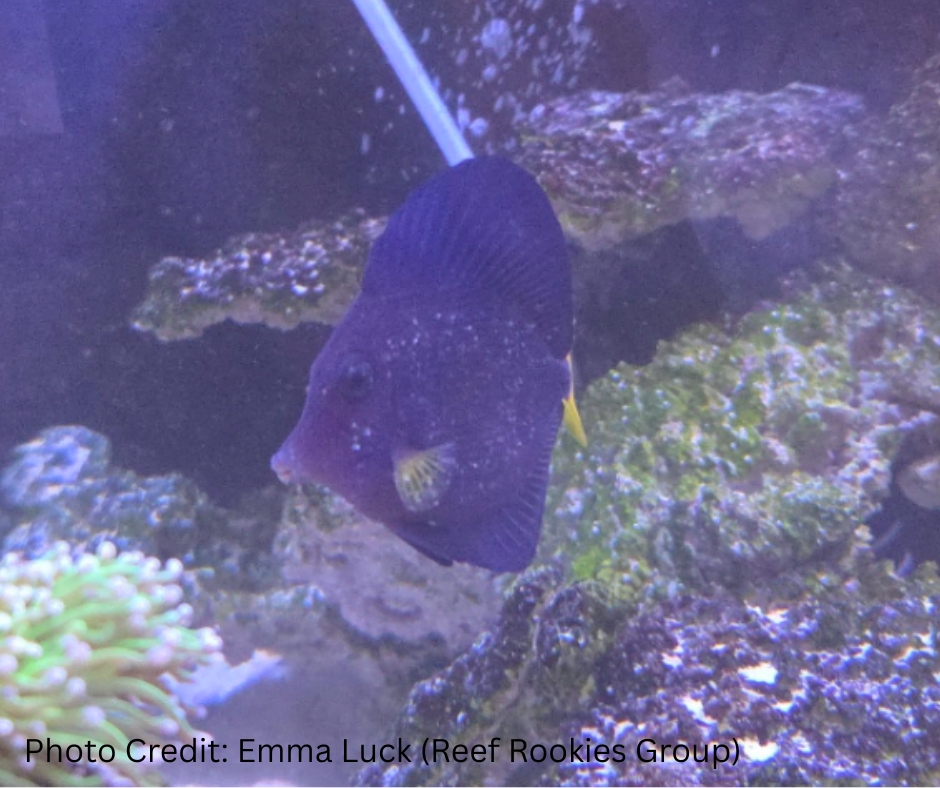
Marine Ich is one of the most misunderstood problems in reef keeping. You’ve seen it before, someone posts a fish covered in white spots, and the advice in the comments is all over the place. Some people say to use a reef-safe bottled treatment, others recommend garlic, some say to lower the temperature, and a few jump straight to tearing the entire tank down. The reality is that most of this advice is either incomplete or flat-out wrong, and the confusion comes from a lack of understanding of what marine ich actually is.
Marine Ich, or Cryptocaryon Irritans, is not a bacteria, not a fungus, and it is not caused by poor water quality. It is a parasitic protozoan with a defined life cycle. That life cycle is the single most important thing to understand because every success or failure in treating ich comes down to whether or not you are interrupting that cycle effectively.
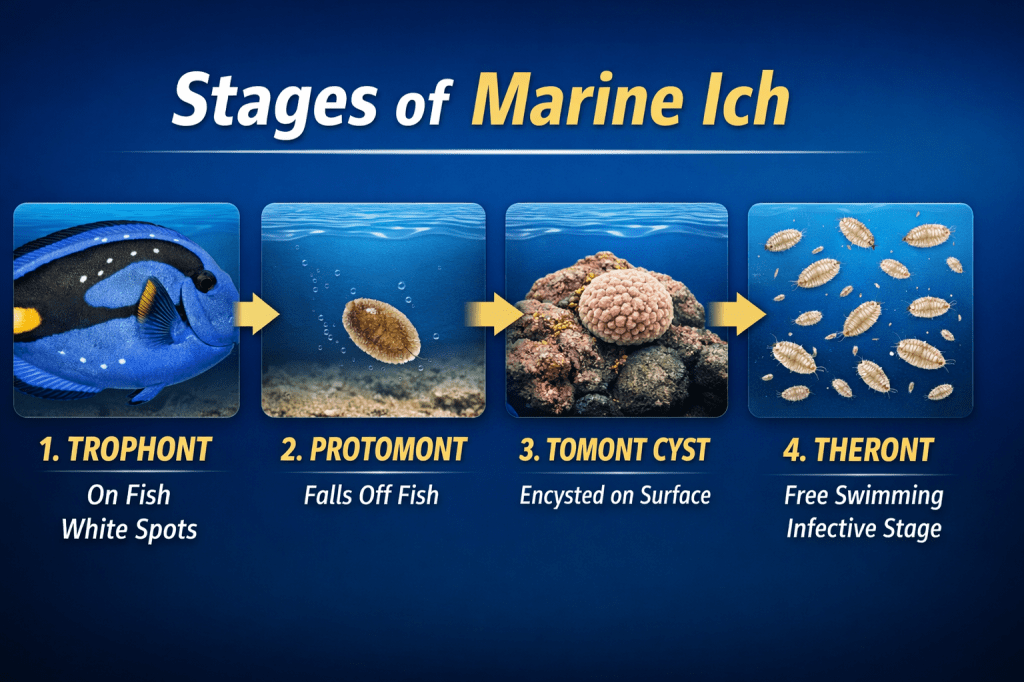
The Life cylce of Cryptocaryon Irratans (Marine Ich)
The first stage is the Trophont Stage, which is the one you actually see on the fish as white spots. At this point, the parasite is embedded in the fish’s tissue and protected by the slime coat, making it extremely resistant to treatment. This is one of the biggest reasons why so many “reef-safe” medications fail. They simply cannot penetrate this stage.
After this, the parasite transitions into the Protomont Stage, where it drops off the fish and falls into the substrate or onto hard surfaces in the tank. This is often where hobbyists think the problem has gone away because the visible spots disappear, but in reality, the parasite is just moving to its next phase.
Next, it becomes a Tomont, which is the reproductive stage. During this phase, the parasite encysts on hard surfaces like rocks, glass, pumps, frag plugs, and even snail shells. Inside that cyst, it multiplies into hundreds or even thousands of new organisms. This stage is heavily protected and essentially immune to most treatments, which is why dosing something into your display tank rarely solves the problem.
Eventually, these cysts release free-swimming Theronts into the water column. This is the only stage where ich is truly vulnerable. These organisms are actively searching for a fish host, and if they find one, the entire cycle starts over again.
Understanding this cycle makes it clear why most treatments fail.
Why Most Treatments Fail
Lowering the temperature does not kill ich. It can survive in a wide temperature range and will simply go dormant outside of it, only to return when conditions improve.
Garlic does not kill ich in a reef tank either. At best, it encourages fish to eat more, which can help strengthen their immune system, but it has no meaningful impact on the parasite itself.
Ginger is even less supported, with no credible evidence showing it has any effect in saltwater systems.
As for bottled “reef-safe” treatments, there are none that completely eradicate ich from a display tank. Some may reduce the population slightly, especially in the free-swimming stage, but none of them address every stage of the life cycle.
What Actually Works & Why
The only reliable way to eliminate ich is to break that life cycle completely.
The most effective method is removing all fish from the display tank and placing them into a quarantine system where they can be treated, typically with copper at a controlled therapeutic level. At the same time, the display tank must remain fishless for a minimum of 76 to 80 days. Without a host, the parasite cannot complete its life cycle and eventually dies off. This process requires patience and discipline, but it is proven to work.
There are other methods, such as the tank transfer method, which involves repeatedly moving fish between sterile tanks to prevent the parasite from completing its cycle. While effective, it is extremely labor intensive and impractical for many hobbyists.
Hyposalinity is another option, but it requires maintaining an extremely precise salinity level and carries significant risk to certain fish species.
UV sterilization can help reduce the number of free-swimming parasites, but it only works on those that actually pass through the unit, making it a management tool rather than a cure.
How Ich Gets Into Your Tank
One of the most important things to understand is how easily ich enters a system. The most common source is unquarantined fish, but it can also be introduced through corals, frag plugs, invertebrates, water from another tank, or even wet tools. If it is wet, it has the potential to carry ich into your aquarium. This is why proper quarantine procedures are so critical, not just for fish, but for everything that goes into the tank.
Final Thoughts
The reality that many hobbyists struggle to accept is that most marine systems will eventually encounter ich. Once it is present, you are either actively managing its population or taking the necessary steps to eradicate it completely. Managing it means keeping fish healthy and stress low so they can tolerate the parasite, while eradication requires strict quarantine practices and a willingness to follow through on a full fallow period.
This leads to the most important mindset shift in reef keeping when it comes to ich. You are not treating symptoms. You are either managing or interrupting a life cycle. Once you understand that, the confusion disappears, and the idea of quick fixes or miracle cures stops making sense. Success comes from patience, consistency, and a clear understanding of how this organism actually behaves.
There is no shortcut with marine ich. There is no magic bottle, no instant solution, and no truly reef-safe cure that will eliminate it from a display tank. There is only knowledge, discipline, and time. That is how you win.


 Reef Rookies - Respectful Reef Keeping
Leave a comment