If you’ve ever gone to admire your tank and discovered a brown, slimy, melting mess taking over your coral, you’ve met Brown Jelly Disease. And here’s the reality: it will happen to you at some point if you keep enough corals. This isn’t bad luck just part of reef keeping.
What is BJD?
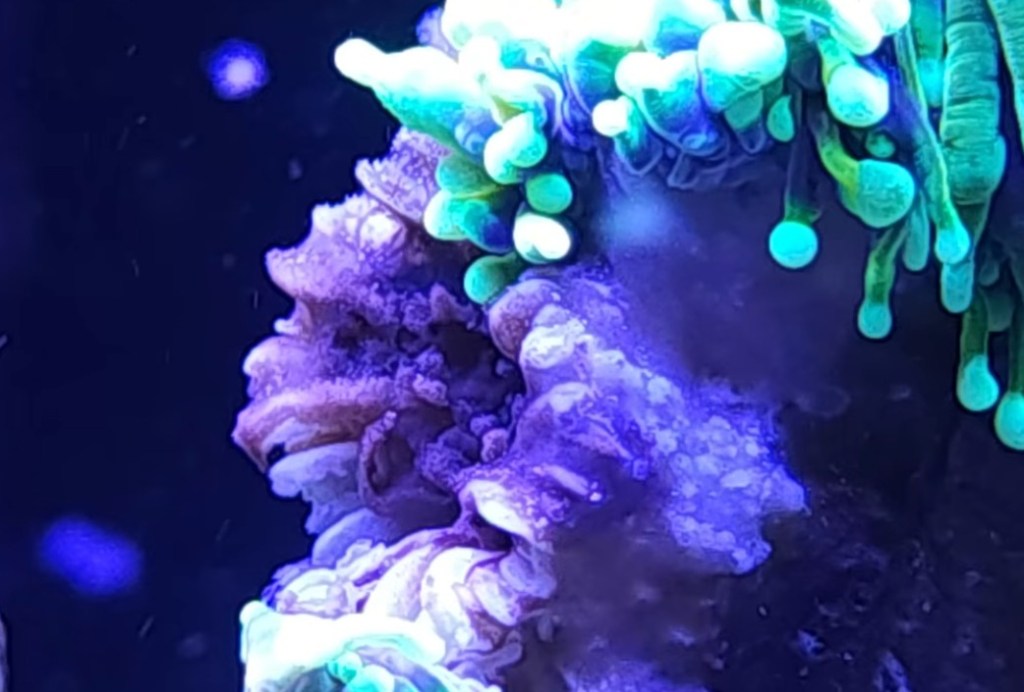
Brown Jelly Disease, or BJD, is a rapidly progressing coral tissue infection that can destroy a colony in a matter of hours. At its core, it isn’t caused by a single pathogen. Instead, it’s a breakdown of the coral’s internal microbiome. The same beneficial bacteria that normally exist within the coral suddenly shift and become pathogenic, multiplying out of control alongside other organisms like protozoa. The result is that unmistakable brown, gelatinous mass that appears to be consuming the coral in real time.
BJD is most commonly associated with LPS corals like torches, hammers, frogspawn, and octospawn but can also affect corals such as trachyphyllia, lobophyllia, and acanthastrea. Even some SPS species can fall victim to it. Nothing in your tank is completely immune, which is why understanding it is so critical.
How To Identify BJD
One of the most important aspects of BJD is recognizing it correctly. It is not the same as polyp bailout, where a coral ejects its polyp, nor is it standard recession where tissue pulls back into the skeleton.
BJD is obvious and aggressive. The coral appears to be melting, with brown slime covering the tissue, and in many cases, pieces of that tissue will literally break apart and drift through the water. When you see that, you need to act immediately.
What Causes BJD?
BJD almost always follows some kind of stress event. The infection itself is not the initial problem. It’s the result of something going wrong beforehand.
Physical damage is a major trigger, whether that comes from fragging, shipping, dropping a coral, or even a fish or invertebrate irritating the tissue.
Water instability, especially swings in alkalinity, pH, or salinity, as well as poor overall water quality can be the cause. Elevated dissolved organic carbon can also play a significant role, particularly after events like macro algae crashes.
Flow is a critical factor that is often overlooked. Corals need random, turbulent flow that constantly shifts direction. When flow becomes stagnant or overly laminar, it creates the perfect environment for BJD to take hold.
Biological imbalances such as dinoflagellate or diatom blooms, antibiotic use (even at normal doses) and sudden environmental changes can act as catalysts. Even something as seemingly harmless as spot feeding can create issues, especially with euphyllia-type corals. These corals do not need to be spot fed, and uneaten food can become trapped within the coral, begin to decay, and ultimately trigger the very infection you are trying to avoid.
What makes BJD especially dangerous is how quickly it spreads. It can move from one polyp to another in a matter of hours, and it is entirely possible to lose half or more of a colony in a single day. Because of this, your response has to be immediate and decisive.
How to Treat BJD
It’s important to remember that you are not saving the infected tissue. You are trying to save what’s left.
Step 1: Remove the Coral Immediately
Do NOT wait.
Before touching anything:
- Turn off ALL flow (wavemakers, return pump)
Why?
To prevent spreading infected material through the tank.
Then:
- Carefully remove the coral
- Move slowly. Do not shake or slough tissue
- Transfer to a separate container with tank water
Step 2: Optional Pre-Clean (Highly Effective)
Before removal or in a separate container:
- Use tubing as a siphon to vacuum off the brown jelly
Yes, you may lose some tissue.
That tissue is already gone anyway.
Step 3: Rinse and Clean
In a separate container:
- Use a turkey baster to blast water through the skeleton to remove all visible infection.
Discard that water.
Step 4: Frag If Needed
If infection is localized:
- Cut off infected heads completely using a Dremel (diamond wheel) or coral band saw
Avoid crushing tools on thick skeletons.
Step 5: Iodine Dip (Best Method)
Your best weapon: Lugol’s iodine
Why?
- Antiseptic (not antibiotic)
- No resistance buildup
- Irritates bacteria/protozoa → they detach
Mix:
- ~1 dropper iodine per ½ gallon saltwater
- Aim for light tea color
Dip duration:
- 15 minutes → up to 1 hour
Goal:
Stop the spread and save healthy tissue.
Step 6: Quarantine
Do NOT return coral to display.
Instead:
- Place in QT or frag tank
- Provide proper light and flow
- Monitor closely
Only return once fully stabilized.
Step 7: Fix the Root Cause
Back in the display tank:
Check EVERYTHING:
- Flow (random, turbulent?)
- Lighting (PAR still correct?)
- Parameters (stability, not just numbers)
- Equipment failures
If you don’t fix the cause, it will happen again.
What not to do
One of the most important considerations in all of this is what not to do. The use of antibiotics in a display tank is strongly discouraged. While it may be tempting to reach for solutions like ciprofloxacin or other antibiotic treatments, these substances do not discriminate between harmful and beneficial bacteria. Introducing them into the display can disrupt the entire microbial ecosystem, potentially leading to ammonia spikes, bacterial blooms, oxygen depletion, and long-term instability. In some cases, this can cause more damage than the original problem.
Beyond the immediate risks, antibiotics also fail to address the root cause of BJD. They may temporarily suppress symptoms. They will not remedy the underlying cause, whether it be flow, water quality, or stress and the problem is likely to return. Additionally, the overuse of antibiotics raises broader concerns about resistance, which is an issue not just in reefkeeping, but across all biological systems.
If antibiotics are ever used, they should be reserved strictly for isolated quarantine systems and followed by efforts to restore the coral’s microbiome and overall health. The display tank, however, should remain focused on stability, balance, and natural biological processes.
 Reef Rookies - Respectful Reef Keeping
Leave a comment