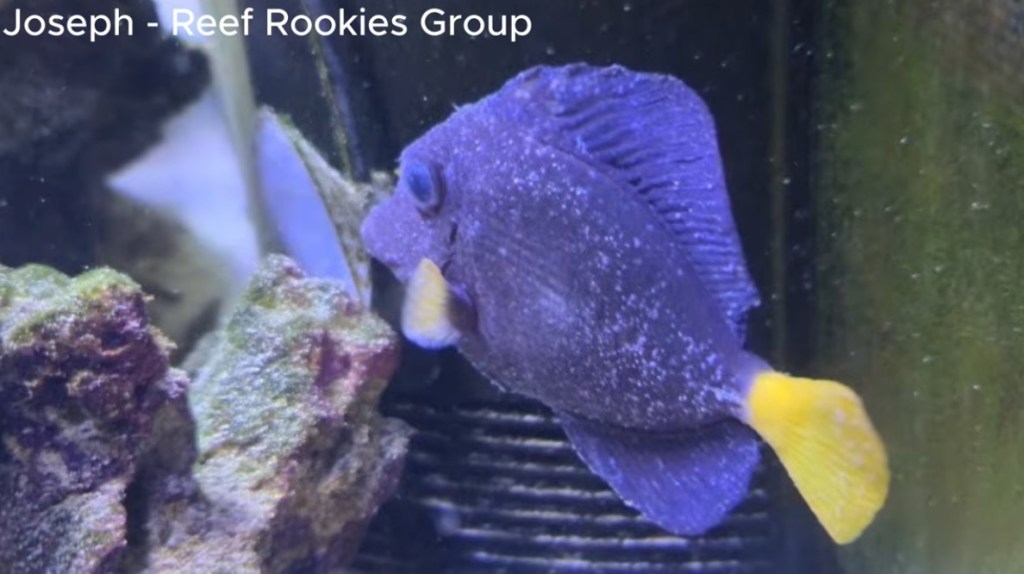
Marine velvet is one of the most aggressive and deadly diseases we encounter in reef aquariums. It can wipe out an entire fish population in as little as 48 hours. Because of that, speed, accuracy, and decisiveness are everything when dealing with this pathogen. Waiting to “see what happens” is not an option here. If you suspect velvet, you MUST act immediately.
What Makes Marine Velvet so Dangerous?
Marine velvet is caused by Amyloodinium ocellatum, a parasitic dinoflagellate. What makes it especially dangerous is a combination of two factors: its rapid life cycle and its ability to infect fish before visible symptoms appear.
This parasite primarily attacks the gills first, impairing respiration. As the infestation grows, fish essentially suffocate. Because this happens internally before obvious visual signs appear, it’s entirely possible for the entire tank to become infected before you even realize something is wrong.
The complete life cycle of Marine Velvet is as little as 3 to 6 days, allowing populations to explode at a logarithmic rate if left untreated.
Recognizing The Symptoms
Behavioral Indicators (Early Warning Signs)
The earliest signs are often behavioral, and catching these can be the difference between saving your fish and losing them.
Rapid or heavy breathing is one of the first indicators, as the gills are under attack. Fish may also begin staying in high-flow areas, essentially trying to force more oxygen across their gills. Lethargy and loss of appetite often follow.
Another key sign is unusual hiding behavior. Because velvet is photosynthetic, it becomes more active under light. Infected fish may retreat into shaded or dark areas to escape irritation.
Visual Symptoms (Often Late Stage)
Visually, velvet appears as a fine, dusty coating over the fish, sometimes with tiny white or gold specks. This is often mistaken for sand or even marine ich. Unlike ich, however, the spots are much smaller and more numerous, creating a powder-like appearance.
Other visual signs include clamped fins, darkened patches, and in many cases, sudden unexplained death.
Understanding the Life Cycle
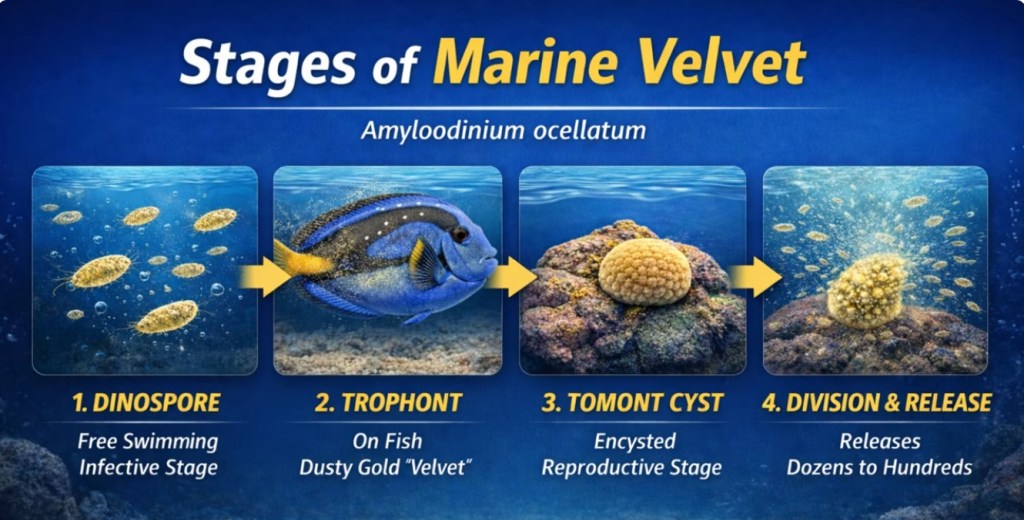
Marine velvet progresses through three main stages, and understanding this is critical to effective treatment.
The first stage is the free-swimming dinospore, which searches for a host. Once it finds a fish, it attaches and becomes a trophont, feeding on the fish’s tissues. After a short period, it detaches and encysts on a hard surface as a tomont, where it reproduces rapidly.
Each tomont can release up to 256 new dinospores, restarting the cycle and driving exponential growth in the population.
This explains why outbreaks escalate so quickly and why treatment must target the correct stage.
Two-Phase Treament Strategy
Effective treatment requires a two-phase approach:
Phase 1: Temporary Symptom Relief
These methods help reduce parasite load and allow fish to breathe, but they do NOT cure the disease.
- Freshwater (RODI) bath
- Hydrogen peroxide bath
- Ruby Reef Rally Pro bath
- Formalin bath
These treatments work by causing attached parasites to fall off the fish, reducing immediate stress and improving respiration. Think of this as using an inhaler. It helps the fish survive long enough for proper treatment to begin.
Phase 2: Permanent Treatment (Quarantine Only)
All permanent treatments MUST be done in a quarantine tank. Never treat in a display tank.
Copper Treatment
- Target range: 1.5–2.0 ppm
- Raise copper slowly over several days
- Maintain therapeutic level continuously
- Minimum duration: 14 days (21 days preferred)
- Observation period: 42–45 days total
Important notes:
- Use a reliable test method (High Range Hanna checker recommended)
- Pre-dose replacement water before water changes
- If copper drops below therapeutic level, treatment resets
Chloroquine Phosphate Treatment
- Dosage: 10 mg per liter
- Duration: 10–14 days
Precision is critical. Underdosing will fail, and overdosing should only be done cautiously in severe cases.
Tank Transfer Method (TTM)
- Transfer fish between sterile tanks every 1–2 days
- Repeat 5–7 transfers
- Clean and sterilize tanks between uses
This method breaks the life cycle without medication but requires strict timing and significant effort.
Display Tank Protocol (Fallow Period)
To eliminate velvet from your display tank:
- Remove ALL fish
- Leave tank fallow for 6–7 weeks
Even one remaining fish can sustain the parasite population and restart the outbreak.
What Does NOT Work
- Hyposalinity (velvet tolerates 12–50 ppt)
- Temperature manipulation (survives 60°F–86°F)
- “Reef-safe” bottled cures
- Waiting to confirm diagnosis
Velvet can go dormant outside optimal ranges but is not killed, meaning it can return later.
Prevention Strategies
Prevention is the most effective tool against marine velvet.
Quarantining all new fish is essential, even if they appear healthy. Ideally, everything entering the system should be quarantined, including corals, snails, and hermits. Removing corals from frag plugs further reduces risk.
Avoid cross-contamination by using separate tools for each tank. Even water droplets can transfer the parasite, so physical separation of quarantine and display systems is strongly recommended.
Maintaining stable water parameters also helps reduce fish stress, improving their ability to resist infection.
UV sterilizers can help reduce free-swimming parasites, but they are not a standalone solution. Ozone may be effective but should only be used by experienced aquarists due to safety risks.
 Reef Rookies - Respectful Reef Keeping
Leave a comment